Fork N Sausage
- 4.6
- Rating
- 50.00M
- Installs
- Free
- Price

 Analysis by App-foxy
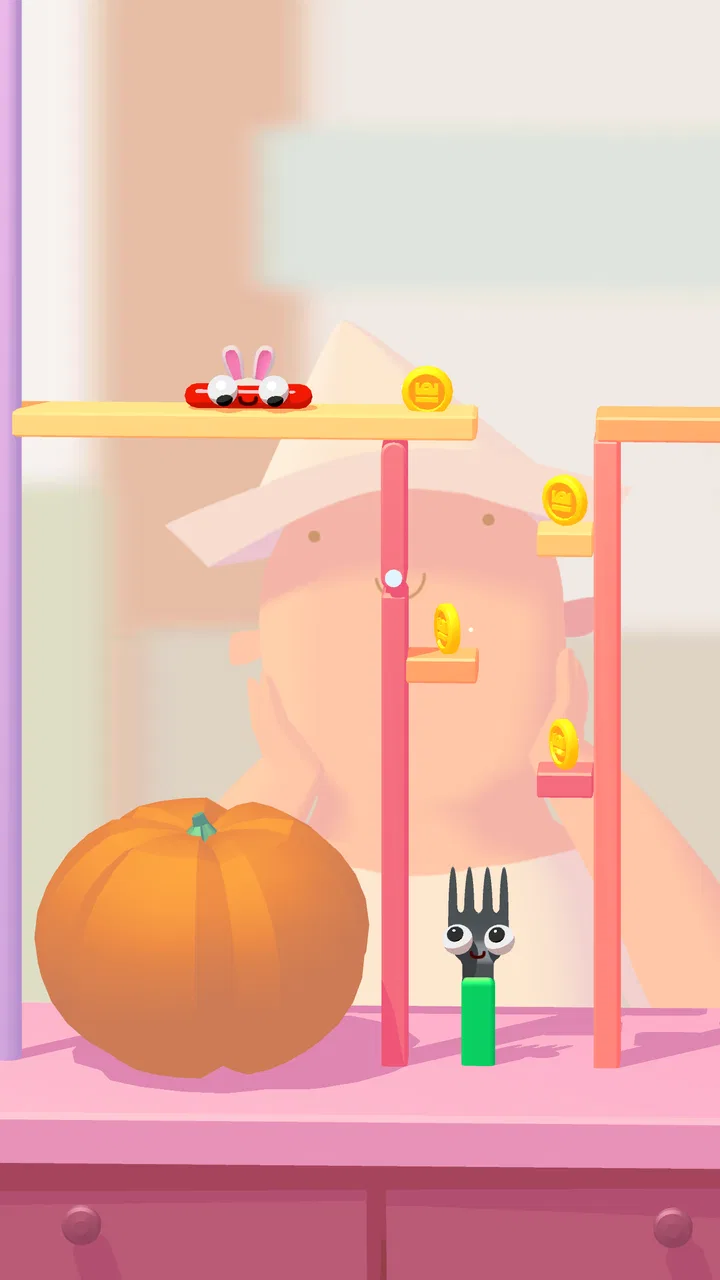
I spent time with Fork N Sausage as a lighthearted puzzle game, and my first impression was clear: it wants to make solving levels feel playful rather than serious. You guide a sausage and use a fork as part of the action, with each stage built around timing, movement, and figuring out how to reach the next goal. It is the kind of game I can open for a short break without needing a long explanation first.
That simple setup hides a surprisingly important distinction. This is not a traditional logic puzzle where I sit quietly and work through one abstract problem at a time. It mixes puzzle solving with action, visual comedy, and quick reactions. Sometimes I was thinking about the correct route; at other moments, I was concentrating on the timing of a move. That combination gives it personality, but it also means the game will not suit everyone who normally looks for a puzzle title.
How the game feels in everyday play
My favorite way to play was in short sessions. If I had a few minutes while waiting for something, the game gave me an immediate activity without demanding a large time commitment. The levels are presented as small challenges, so I could attempt one, learn from a mistake, and try again without feeling that I had lost a major investment of time.
You May Also Like

 Blood Strike: 2.5 Anniversary
Blood Strike’s Loadouts Turn Every Drop Into a Tactical Gamble
A close look at Blood Strike’s custom loadouts: how fast access to signature weapons reshapes its battle royale rhythm, rewards preparation, and narrows the gap between fights.

 Pandora - Music & Podcasts
Pandora’s Music Is Easy to Start, but Harder to Recover
Pandora’s strength is its low-effort path from a seed to a station. Its weak spot is how much confidence it asks you to place in connection, setup, and quiet recovery.

 8 Ball Pool
 Is Built on Rivalries, Rematches, and Routine
A close look at the rivalries, rematches, shared routines, and unanswered safety questions that turn a quick pool match into a persistent mobile community.

 Samsung Music
’s Quiet Strength Is Playing What You Already Own
Its reach comes less from spectacle than from dependable access to a personal library. That simplicity is both the app’s strongest retention engine and its ceiling.

 AccuWeather: Weather Radar
AccuWeather Review: A Quick, Clear Forecast for Everyday Decisions
For everyday plans, the best forecast is the one you can understand quickly. AccuWeather makes rain timing, radar, and local conditions easy to act on, with a few trade-offs.

 Hill Climb Racing
Why Hill Climb Racing Still Turns Crashes Into One More Run
A tiny car, a bumpy hill and one more upgrade: Hill Climb Racing keeps resurfacing because its simple chaos makes every near-miss feel personal.
More From Our News Desk
View All News


The central appeal comes from turning an ordinary food item into the character I control. The fork is not just decoration; it helps create the physical joke behind the puzzles and gives the game its recognizable identity. That visual idea makes the experience easier to remember than a standard collection of anonymous blocks, tiles, or numbered shapes.
I also noticed that the humor works best when I stop treating every failure as a setback. A failed attempt often feels like part of the joke, especially when I misjudge a movement or approach a puzzle with the wrong idea. That tone matters because action-puzzle games can become irritating when mistakes feel harsh. Here, the presentation encourages experimentation, even though repeating a difficult section can still become tiring.
At its core, the game belongs to the puzzle category, but I would describe it to a friend as a puzzle-action hybrid. It asks me to understand the level, recognize hazards or obstacles, and then execute the solution. Players who enjoy only slow, methodical brainteasers may find the action layer distracting. Players who like a little movement and slapstick energy alongside their puzzles are more likely to appreciate the formula.
Why the unusual theme matters
The food-based theme is more than a visual skin. It gives the game a deliberately silly mood, which changes how I respond to the usual trial-and-error structure. Instead of feeling like I am solving a formal exercise, I feel as if I am helping an absurd character survive a series of increasingly awkward situations.
That tone makes it approachable for casual players. Someone who does not usually choose puzzle games may be willing to try it because the presentation feels friendly and funny. The Everyone content rating also makes it a reasonable choice for families who want a simple game to sample together, although younger players may still need help with sections that depend on timing or repeated attempts.
The same theme can be a limitation for people who prefer a calm or elegant visual style. If you want minimalist geometry, wordplay, or a deep strategy system, the comic food premise may feel too noisy. I found the silliness enjoyable, but it clearly defines the audience rather than trying to appeal to every puzzle fan.
Learning the controls without a long tutorial
One practical strength is how quickly I could understand the basic idea. The game does not need a complicated rulebook to explain why the fork and sausage matter. I could begin experimenting almost immediately, then refine my understanding through the level design.
That approach is useful on a phone because mobile games compete with interruptions. I do not want to study a control scheme before deciding whether a game is worth my time. Here, the early experience is built around discovering what movements work, which makes the opening feel active instead of instructional.
There is a trade-off, though. When a game teaches through experimentation, a failed attempt may be the only way to understand a rule. I sometimes knew what the game wanted me to do only after trying the wrong action. That can be satisfying when the lesson feels fair, but it can also feel vague when I am unsure whether the problem is my strategy or my timing.
My useful tip is to separate those two problems. On the first attempt, I focus on identifying the route and the important interactive elements. On the next attempt, I concentrate on execution. Trying to solve the entire puzzle and perform every movement perfectly at once made me repeat mistakes unnecessarily.
What I found valuable beyond the obvious premise
The strongest hidden benefit is that the game trains flexible thinking without presenting itself as a serious brain-training tool. I often began a level with one assumption about the correct path, then had to abandon it when the movement did not behave as expected. That habit of testing, observing, and revising is more useful here than simply memorizing a solution.
A second practical insight is that the game rewards patience with positioning. Moving quickly is not always the best answer. I had better results when I paused to look at the arrangement of the level and considered where the sausage would end up after an interaction. This is especially helpful for players who tend to tap repeatedly when a puzzle becomes confusing.
A third trade-off appears when playing in public or around other people. The comedic style makes the game easy to show someone else, and a friend can understand the premise within moments. However, the action-focused sections may be less comfortable when I am distracted by conversation. For a commute or waiting room, it works best when I have enough attention to react rather than merely passively watch the screen.
I also found it useful as a reset between demanding tasks. It is not a replacement for a deep strategy game, but it can shift my attention away from work without requiring the commitment of a long campaign. The short-puzzle format gives me a clear stopping point, which is valuable when I know I will need to return to something else soon.
Cost, value, and the points where patience matters
The game is free to download, so the first decision is easy: I can try the core experience without paying upfront. That matters for a casual puzzle title because the unusual premise may appeal to one player and miss completely for another. Free access lets me make that judgment through play rather than through screenshots alone.
Optional in-app purchases are listed at $3.99 to $6.99 per item. I treat that as a reason to consider how I play rather than as an automatic flaw. If I am happy with a free, humorous puzzle game and do not feel pressure to buy anything, the entry cost is attractive. If I dislike interruptions or expect every convenience to be included immediately, the purchase structure may affect my enjoyment.
The important value question is not whether the game is free in a narrow sense. It is whether the free access gives me enough enjoyable play to justify keeping it installed. In my experience, the answer depends on whether I like trial-and-error action. The game delivers value through its distinctive theme and quick challenges, not through the depth of a large strategy system.
I would not buy anything simply because I had failed a level several times. My better approach was to take a break, return with a different plan, and decide whether I still enjoyed the challenge. Paying for convenience only makes sense if the game has already earned a place in my regular rotation. For a first-time player, trying the free version is the sensible order.
The developer is SayGames Ltd, and the game has reached over 50 million installs with an average rating of 4.6 from around 459 thousand ratings. Those figures suggest that the unusual concept has found a broad audience, but they do not remove the personal question of fit. Popularity can tell me that the game is worth sampling; it cannot guarantee that its particular mix of comedy, movement, and puzzles will match my taste.
Where it differs from usual puzzle alternatives
Compared with a classic match-three game, this title asks for more active involvement. I am not mainly scanning for identical pieces or building a long chain. The challenge comes from understanding a situation and carrying out a physical solution, so it feels more like a small interactive puzzle scene than a purely pattern-based pastime.
Compared with a word puzzle, it is less dependent on vocabulary and more dependent on visual interpretation. That makes it easier to share with someone who speaks a different language, but it also means that careful reading is not the main skill being tested. Players who want daily word practice should choose a dedicated word game instead.
Compared with a slow physics puzzle, Fork N Sausage is more openly comedic and action-oriented. It does not present itself as a quiet laboratory for precise experiments. The food theme and quick attempts make it more approachable, while the trade-off is that players seeking highly controlled, contemplative problem solving may find the presentation less refined for their preferences.
Compared with a large strategy game, it is much easier to start and stop. I do not need to remember a complex economy, a long-term build, or a detailed campaign plan. That is a real advantage for casual sessions, but it also means I should not expect the same sense of progression or strategic ownership that a deeper game can provide.
Who will get the most from it
I recommend it most to players who enjoy amusing concepts, short mobile sessions, and puzzles that require both thought and timing. It is particularly suitable for someone who wants a game that feels different from the usual tile, word, or number options. The sausage-and-fork idea gives it an immediate hook, and the free entry point makes experimenting low-risk.
It can also work for families or friends who like watching each other attempt a level. The rules are easy enough to explain verbally, and the comic failures create natural moments for discussion. One person can suggest a route while another handles the controls, although the final execution still depends on the person playing.
I would be more cautious about recommending it to players who want no trial and error. If every failed attempt feels like wasted time, the game may become frustrating. The same applies to anyone looking for a relaxing puzzle with no action pressure. In those cases, a slower logic, word, or number game would probably be a better match.
It is also not my first choice for someone who expects a premium-style experience with no optional spending considerations. The game is free, and the listed purchases range from $3.99 to $6.99 per item, so I would decide in advance whether I am comfortable enjoying it without buying anything. That boundary helps keep the value judgment clear.
Device and age considerations
The game supports devices running Android 8.0 or later. That makes checking the operating system worthwhile before trying to install it, particularly if I am using an older phone or tablet. On a compatible device, the main consideration is less about technical ambition and more about whether the screen is comfortable for the action-oriented controls.
The current version is 3.25.11, which is useful to know when comparing installation information across devices. I would still keep the game updated through the normal app store process, since mobile games can change their behavior or presentation over time. I would not assume that an older installation will feel identical to the current release.
The Everyone rating reflects the broadly accessible tone I experienced. The humor is built around the absurd character and the puzzle situations rather than mature subject matter. Parents should still decide whether the repeated attempts and optional purchases fit their household rules, but the game itself is designed as an accessible casual experience.
My verdict after weighing the trade-offs
For me, the strongest reason to keep playing is its personality. Many mobile puzzle games are easy to understand but difficult to remember. This one has a clear visual joke and a specific interaction between the fork and sausage, so it stands out when I am choosing something for a quick break.
The main weakness is equally specific: the blend of puzzle solving and action will not satisfy players who want only one of those things. A level can be logically understandable and still require several attempts because the execution is not right. I enjoyed that tension in moderation, but I would not describe it as universally relaxing.
My practical recommendation is to treat it as a free sampler first. Play it when you want short, funny challenges, and judge the value by how often you voluntarily return rather than by the size of the install base or rating. If you enjoy discovering routes, correcting mistakes, and laughing at a deliberately ridiculous premise, it earns a place on a casual gaming device.
If you prefer deep strategy, serious storytelling, wordplay, or completely calm logic exercises, I would skip it in favor of a game built around those strengths. For everyone else, the low-risk starting point makes it easy to test. Its best value comes from the combination of free access, memorable humor, and compact puzzle-action sessions, provided I accept that some challenges ask for patience as well as cleverness.
Overall, I found it easy to recommend to a friend who wants something playful rather than profound. It does not try to be a grand puzzle masterpiece, and that is part of its charm. It aims to make a few minutes entertaining, gives the familiar puzzle format an unusual character, and offers enough variety in the way I approach levels to keep the experience from feeling like a generic collection of brainteasers.
FAQs for Fork N Sausage
01What is Fork N Sausage, and how does it work?
Fork N Sausage is a fun and engaging puzzle game where players must use a fork to navigate various levels and skewer sausages. The game combines elements of strategy and physics as you maneuver through obstacles and solve challenging puzzles. Each level presents unique scenarios, requiring creative thinking to progress.
02Is Fork N Sausage free to play, or does it require in-app purchases?
Fork N Sausage is free to download and play, offering a range of levels that can be enjoyed without any cost. However, the game may include in-app purchases for additional content, power-ups, or to remove ads, enhancing the gaming experience for those who choose to invest a little further.
03What devices are compatible with Fork N Sausage?
Fork N Sausage is available for both Android and iOS devices. It requires Android version 5.0 or higher and iOS version 10.0 or later. The game is optimized for both smartphones and tablets, ensuring a smooth and enjoyable experience across different devices.
04How can I improve my skills in Fork N Sausage?
To improve in Fork N Sausage, start by understanding the physics and mechanics of the game. Practice makes perfect—replay levels to get a better grasp of timing and angles. Watching online tutorials or gameplay videos can also provide new strategies and tips to tackle more difficult puzzles.
05Are there any social features in Fork N Sausage?
Yes, Fork N Sausage includes social features that allow you to connect with friends and share your progress. You can compete on leaderboards, compare scores, and challenge friends to beat your records. These features add a competitive edge and make the game more interactive and fun.
Pros
- Engaging and unique puzzle mechanics.
- Colorful and amusing graphics.
- Challenging levels that keep you hooked.
- Smooth and responsive controls.
- Regular updates with new content.
Cons
- Ads can be intrusive at times.
- In-app purchases may be pricey.
- Some levels feel repetitive.
- Requires internet for some features.
- Limited hints available without purchase.

Fork N Sausage
Gallery